

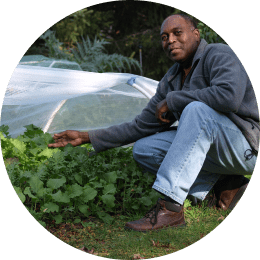
While many of us are still watching snow melt and feeling the bite of winter, there are others who have been basking in the warmth of spring for some time now. Today Churchill returns to share some of the activity and growth taking place in her organic vegetable garden in Patzcuaro, Mexico…
We had a strange winter. It was supposed to be the dry season, but we got more rain than we did in the wet season. So I spent the few dry days we had in January working up the new beds and bolstering the old ones.
Over Wintered Plantings and New Spring Growth
Planted red-top turnips in late November and they are prolific. The rhubarb came on strong with the hail storms, and the Swiss chard, spinach and kale and lettuces came through very well.
I have artichokes that seemed to flourish on the cold and rain. The horseradish is sprouting new tops. The beans did well, and I am planting more. I also have collards, mustard and endive coming in. I plant straight into the ground. And the trees are showing their spring green, and the fruit trees are beginning to blossom.
Using Sand and Raised Beds to Help Improve Soil Structure
We are also building soil for a larger patch in the field. We have red hardpan clay. So we’re laying volcanic sand over the clay, and then burying it in wheat straw, a layer of cow manure and then mulch.
After it sets a bit, we pull and mix it together and form our raised beds, which are about 18″ high. I have already planted one long row with cabbage, broccoli, cauliflower, and a few artichokes. We made a squash bed tucked behind the east garden wall where it will get first light and some relief from the late afternoon sun that is so hot.
Trellising Peas, Beans, Squash, and Tomatoes
We are using the garden wall to string up our peas, beans, squashes and bush pickles. Going to train my tomatoes on the walls, too, and see how that works.
I will be adding more variation as I build more rows. Hope to have some good rows ready before June when the rains begin. The most damage we received was to our flowers, we had some wicked hail. But it looks like everything is recovering.
Always looking for advice and tips, signed: Churchill from Patzcuaro, Mexico.
Thanks for the report Churchill; it’s always interesting to hear what’s growing in other gardens and in other climates and countries! Churchill is an organic vegetable gardener and previous contributor here on the Veggie Gardening Tips website.
17 Responses
We just finished building our house on the Pacific Coast in Manzanillo Mexico….
I was anxious to start a garden but one of my helpers has informed me that the Mapaches (racoons) will eat everything. Any suggestions to Mapache proof a garden? Is a covered, fenced garden my only hope?
One more thing: would your readers be interested in information on the joys of flower gardening in Mexico? I have quite a few salvias in my garden, but only bought one (a salvia gregii I found in a nursery). The Mexican bush sage descended from seed from my sister’s garden in the US; the salvia patens, mexicana, and iodanthe all came from cuttings collected from wild plants along some highway here. The salvias mexicana and iodanthe have both reseeded in my garden; salvia iodanthe is a spectacular plant that grows up to 10 feet if I let it, but seems to be pretty well unknown in the gardening world — a spectacular display of shaggy magenta blooms for about a month and a half, and the leaves smell wonderful as well! It would be great in a larger garden than mine.
I have pictures if you are interested.
hi paul, I would like to see your pics of the salvia iodanthe. I am also curious about watering vegetables with water that is not potable? Does that matter? Thanks.
sheridan
Oops! I don’t really know how to attach a photo in this format. Instructions?
As for the whole clean water issue, here in the city of Morelia our water is reasonable clean. We don’t drink it, but we do bathe and wash our dishes in it; so if it were that dangerous, the damage would already be done. The big danger in Mexico comes from commercial farmers who irrigate with wastewater or river water, so we soak all our purchased vegetables in an iodine solution. But I don’t do that with my home-growns, and often eat blackberries and tomatoes straight off the vine.
Plus… I haven’t watered once since the rains started in late May. Frankly, we’re swamped with rain this year!
Carol, Have you thought of using a battery powered electric fence. They are most effective and inexpesive, three strands about 150m apart works well.
Hi! I am looking for information on food gardening in Mazatlan, Mexico. I have American friends who work at and are trying to start a garden at Rancho de los Ninos. They have no idea what they are doing, but it would be great for the orphange to be able to grow some of their own food and for the kids to learn how to do this for themselves. Could you recommend a book (in English) that I could send them. I am also hoping to connect them with a local veggie gardener who would be willing to teach them…
Any info would be appreciated. I have an organic veggie garden in Mid-Michigan which is so different from where they are at : ) Thanks, Sara J
I live in Mexico in the state of Puebla. I have always wanted a vegetable garden (my parents always had one), but I have never done it before. Wanting to start a container vegetable garden on my patio … but at a bit of a loss. I don’t know of anyone here who has their own vegetable garden (not a common hobby I guess). The local greenhouses mostly have decorative plants … but not edibles. Not sure where to look for seeds, starters, fertilizer, etc. Can anyone who has had a vegetable garden in Mexico give me some tips? 🙂
Hello, Angela! (Also my wife’s name, by the way.) You can certainly have a vegetable garden in Mexico, year-round, but with some significant limitations.
Your best bet is to find a Home Depot store, most likely in the city of Puebla. They sell all sizes of pots, potting soil, and fertilizer. They also have a decent selection of vegetable seeds, but anywhere in Mexico, you can just forget about varieties. Broccoli seeds, for example, are just sold in a package marked “brocoli”, and purple or sprouting varieties are out of the question. My solution? Smuggle your seeds from the US! (Technically not allowed, I can’t imagine why, but seed packages are incredibly easy to hide, even in a coat pocket.)
You can forget about buying prestarted veggie seedlings, so seeds are your only options. The only starter systems are peat pots or expandable tablets, and I only find those in Home Depot these days. (Ace Hardware no longer carries them.) I prefer starting my seedlings in recycled plastic containers; you can make your own individual “pots” from newspaper to bring seedlings (especially tomatoes) to full size, and then plant them newspaper and all. Or buy a good seed-starting system in the US and reuse the plastic trays until they fall apart.
Some big grocery stores also sell small bags of potting soil and fertilizer, and even a few vegetable seeds.
Going organic is a great choice, since you can use your compost and collected manures to replace some of that expensive potting soil and fertilizer. You can also produce your own non-hybrid seed each year. But purchased organic pesticides (Safer’s soap, Bt., etc.) will have to be imported, as will bird netting, trellis netting, etc. Those are legal!
Have fun! Vegetable gardening in Mexico can be frustrating, but also very, very rewarding. And you won’t have to soak all your vegetables in iodine any more!
Thanks, Paul! Yes, there is a Home Depot in Puebla. I will have to plan to go there the next time I make the trip. I also found this website for anyone who is interested: http://www.bosquedeniebla.com.mx/. It looks like a very cool place! It’s here in Veracruz. They have a catalog where you can order plants and seeds that are organic and probably some uncommon varieties here in Mexico.
Greetings from Palenque Mexico the area is tropacal forest if you want to grow it just plant it . veggies do very well almost year round soil is rich with decomposed foleage a bit rocky . the down side you have to colect your seeds from the vegies you eat and germanate them.
The cardboard core from toilet tissue rolls full of potting mix make a good place to start seeds. It also keeps cutworms from destroying the little seedlings. Happy gardening from Leakey, Texas, USA
dual purpose recycling! I love this…
dual purpose recycling! I love this…
Hi,
I’m also wanting to start a vegetable garden in Manzanillo, Mexico and I’m having a hard time finding any information that could help me get started.
I’ve just bought a bunch of Smart Pots as I heard they are really good to grow tomatoes in.
Any suggestions on what vegetables do better than others, how I can obtain good soil etc…is greatly appreciated.
Thanks!
Laurie
Hi Paul! I read your comment and noticed that you also grow during the rainy season?
I live in Valle de Bravo, just a few hours away from you… This is my first year growing a vegetable gardening, but I am a bit scared since I´ve heard that during our rainy season it is impossible to grow outside?
I would really appreciate your advise.
Gracias!!
Hi Paul! I read your comment and noticed that you also grow during the rainy season?
I live in Valle de Bravo, just a few hours away from you… This is my first year growing a vegetable gardening, but I am a bit scared since I´ve heard that during our rainy season it is impossible to grow outside?
I would really appreciate your advise.
Gracias!!