

Bacillus thuringiensis (B.t.) has been a godsend in battles with destructive caterpillars out in the vegetable garden. One of the most impressive things about Bt (aka Thuricide or Dipel), is that it targets and eliminates bad bugs without harming the non-targeted beneficial insects and pollinators.
B.t. accomplishes this feat because it is based upon a naturally occurring soil bacteria that operates like a stomach virus in causing caterpillars to become sick, quickly stop feeding, and die within days of ingesting 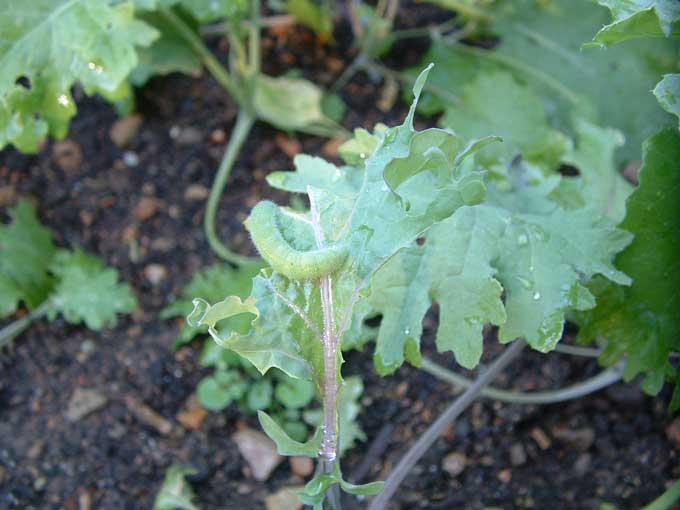 even a small amount of the substance. How does that sound — a “bug” for bugs!
Other things that I like about using Bacillus thuringiensis for organic insect control in the vegetable garden include the following features and advantages:
- Ease of Application – B.t. comes in powered or liquid form. The powder can be dusted onto the plants or sometimes comes in a shaker type dispenser. The liquid version of B.t. is my favorite and is simply mixed with water and sprayed onto your veggie plants.
- Extremely Economical – One reason for my preference of the liquid version of Bt is that it seems to be more economical and a small bottle will go a long way. Kept cool and dry, Bt can be stored over a couple seasons, but I only mix up as much as I need for each application. You should be able to locate an 8 oz. bottle of B.t. for around $10.
- Very Effective – For the usual offenders in the garden Bt has never failed to not just control, but to totally eliminate the pests from my gardens. At the top of my hit list are cabbage worms that attack the heirloom cabbages, kale, broccoli, and other cole crops as summer winds down.
- Bugs Can’t Hide – It only takes a very small amount of Bt in the insect’s system to bring about its downfall, but they must ingest the bacteria in order for it to work. That’s usually not a problem as long as you provide good spray coverage during application.
- Safety Considerations –B.t. is a naturally occurring substance that targets specific insects, which makes it less intrusive on the environment than a broadly toxic pesticide, even the organic types. There are various strains for different insect types; B.t. Kursaki for caterpillar control, B.t. Israelensis for eliminating fly and mosquito larvae, and B.t. San Diego for controlling beetles.
Bacillus thuringiensis is available for use in destroying tent caterpillars, cabbage loopers, cutworms, gypsy moth larvae, budworms, corn borers, tomato hornworms, leafrollers, peach tree borers, webworms, codling moths, and other caterpillars. B.t. is also available for controlling the larvae of black flies, mosquitoes, and fungus gnats, in addition to potato beetles and certain leaf beetles.
Even though B.t. can be safely applied right up to the day of harvest, if there are only a few caterpillars to be dealt with, I still prefer the manual organic control of hand picking instead of breaking out the sprayer or duster. Apply Bt only when there is a definite need to control an identified and targeted insect pest that is present in the garden.
Potential Shortcomings of Using B.t. in the Garden
It sounds all good, but is there a downside to using Bt for organic insect control? Nothing major that I can think of, of course I do treat Bt with the same cautions as any other organic or chemical pesticide. Biological or organic doesn’t infer that a product can be handled haphazardly or be applied without restraint!
B.t. gradually breaks down over time and under exposure to sunlight, and more rapidly due to rainfall, so this biological insecticide will need to be reapplied after a week or two if the insect infestation continues. But in my experience I have usually been able to get by when needed with just a couple, well-timed, applications to control cabbage worms in the fall vegetable garden.
Possibly the biggest issue related to Bt is the potential for future insect populations developing a resistance to Bacillus Thuringiensis. Even though B.t. has been used effectively for decades there have been reports of insects developing a resistance and concerns that commercial attempts at genetic engineering to combine B.t. genes with plants will increase the threat of B.t. resistant insects.

19 Responses
I haven’t yet had to resort to Bt to tackle pests in my vegetable garden, but I’m sure glad to have it in the form of mosquito dunks for my little water feature (a jumbo porcelain pot with some water plants and a little fountain).
If you have standing water in your garden (such as in a rain barrel or pond), you’ll want to make sure it doesn’t become breeding grounds for skeeters.
Luckily I haven’t had too much of a problem with bugs this year. I’m currently planting a liriope groundcover across my backyard. So far everything’s going pretty well. It’s already pretty lush.
This is really great to know. This year I have a problem with japanese bettles, although not as bad as previous years, just a few. I also have seen big black ants and some other little bugs that live on the leaves of my grape plant and the tomato plant also has leaf bugs, don’t know what they are.
Do you know if there’s anything safe to use as a fungicide? I have a few plants that can’t seem to recover, one pear tree I had to literally cut down because of something called Fire ??? um, oh I forget, some kind of fungus that kills plants if not treated.
anyway, thanks for the BT tip, maybe I’ll try it for those darn flies that keep on growing in my trash can area.
Hi Terie, was it “Fire Blight?” If so the first recommendation would be to plant varieties that are Fire Blight resistant. Then remove diseased limbs if the blight does show up, being careful to sterilize your pruners to avoid spreading the blight. There are organic products used to combat fire blight such as Streptomycin, Myco-Shield, and BlightBan.
I wish I knew about this stuff last fall when the cabbage loopers wiped me out. Good to know!
The caterpillar in the picture looks exactly like the ones that consumed most of my white mustard crop last year, so it’s nice to learn about B.T. I didn’t try picking them by hand, maybe I’ll give that a try first should they appear this year to. Good article, thanks!
The caterpillar in the picture looks exactly like the ones that consumed most of my white mustard crop last year, so it’s nice to learn about B.T. I didn’t try picking them by hand, maybe I’ll give that a try first should they appear this year to. Good article, thanks!
Your article is very beneficial for people who care about gardening . Thank you for sparing some time to write about this and post it here.
Once you mix BT, how long is it safe to use? Meaning do you have to use it all up in same setting once mixed or could you mix it and keep it around for a few months> Thanks.
Hi Cynthia, I usually mix up only about as much Bt as I think I will need and apply it right after it is prepared. Not sure how long it will last after it is added to water, but I just don’t like it to sit around for long and always use it up within a few days or so.
Is BT harmful to bees in the garden?
Hi Lisa, as far as I know Bt is not harmful to bees and targets only caterpillar like insects. You should still play it safe and apply it in the evening when the bees are less active and have returned to their hives for the day.
Thanks for the recommendation of this natural insect control. It seems like there are many options when choosing a product remove bugs. Thanks for tips on how to choose the right one.
Thanks for the recommendation of this natural insect control. It seems like there are many options when choosing a product remove bugs. Thanks for tips on how to choose the right one.
I would like to know where to buy the liquid spray bt for vegetable plants.
Anna, you can find Bt for sale at most garden centers or plant nurseries or order it from an organic supply company over the Internet. It may be listed under another name such as Dipel or generically as “organic caterpillar spray” but look at the label and you should see Bt listed as the active ingredient.
Bt is indeed dangerous to bees. Do not spray or dust if there are any bees foraging.